

Fun with Morse Code
Wanted: a short and clever morse code decoder in Haskell. This article presents a series of successively smaller solutions that gradually include computer science concepts like dichotomic search, stack-based languages and finally deforestation, an optimization technique specific to purely functional languages like Haskell.
Table of contents
This article previously appeared in issue 14 of The Monad.Reader.
Introduction
In a post to reddit, user CharlieDancey presented a challenge to write a short and clever morse code decoder. Of course, what could be more clever than writing it in Haskell? ;-)
In the following, I’ll present a series of solutions that gradually include dichotomic search (the straightforward generalization of binary search), stack-based languages or reverse polish notation, and finally deforestation (also called fusion), an optimization technique specific to purely functional languages like Haskell.
For your convenience, source code for the individual sections is available.
A simple first solution
Morse code was designed to be produced and read, or rather heard by humans, who have to memorize the following table:

To write a program that decodes sequences of dots and dashes like
-- --- .-. ... . -.-. --- -.. .into letters, we will have to store this table in some form. For instance, we could store each letter and corresponding morse code in a big association list
type MorseCode = String

dict :: [(MorseCode, Char)]
dict =
    [(".-"   , 'A'),
     ("-..." , 'B'),
     ("-.-." , 'C'),
     ...
which we name dict because it’s a dictionary translating
between the latin alphabet and morse code. To decode a letter, we simply
browse through this list to determine whether it contains a given code
of dots and dashes
decodeLetter :: MorseCode -> Char
decodeLetter code = maybe ' ' id $ lookup code dict
Decoding a whole sequence of letters is done with
decode = map decodeLetter . wordsso that we have for example
> decode "-- --- .-. ...    . -.-. --- -.. ."
"MORSECODE"
Of course, association lists are a rather slow data structure. A binary search tree, trie, or hash table would be a better choice.
But fortunately, it is very easy to change data structures in Haskell.
All you have to do is to a qualified import of a different module, such
as Data.Map, and change the
definition of dict to
dict :: Data.Map.Map MorseCode Char
dict = Data.Map.fromList $
    [(".-"   , 'A'),
     ("-..." , 'B'),
     ("-.-." , 'C'),
     ...
and use Data.Map.lookup instead of
Data.List.lookup.
Dichotomic search
Faithfully replicating the morse code table is clear and preferable, but makes for quite large source code. So, let’s make an exception today and think of something as clever as we can.
The idea is the following: whenever an encoded letter starts with a
dash '-', we know that it can’t be for example an A or E,
because those start with a dot '.'. And if the next symbol
is a dot, then it can’t be a G or M because their second symbol is a
dash. With each symbol we read, more and more alternatives disappear
until we are left with a single alternative. We can depict this with a
binary tree:

At each node, the left subtree contains all the letters that can be obtained by adding a dot to the current letter, while the right subtree contains those letters that can be obtained with a dash. This is illustrated by means of a dotted line connected to the left subtree and a dashed line connected to the right subtree.
Now, to decode a letter, we simply start at the root of the tree and
follow the dotted or dashed lines depending on the symbols read. For
instance, to decode the sequence "-...", we have to go
right once and then left thrice, ending up at the letter B. This
procedure is also called dichotomic search because at
each point in our search for the right letter, we ask a yes/no question
“Dot or dash?” (a dichotomy) that partitions the
remaining search space into to disjoint parts.
Let’s implement this in Haskell. First, we assume that our dictionary is given as a tree
data Tree a = Leaf
            | Branch { tag   :: a
                     , left  :: Tree a
                     , right :: Tree a }

dict :: Tree Char
dict = Branch ' ' (Branch 'E' ... ) (Branch 'T' ...)
Of course, writing out the dict tree in full is going to
be repetitive and boring, but let’s just imagine we have already done
that. Then, decoding a letter by walking down the tree is simply a left fold over the code word
decodeLetter = tag . foldl (flip step) dict
    where
    step '.' = left
    step '-' = right
In this case, the accumulated value of the fold is the current subtree, although the term “accumulate” is a bit misleading in that we don’t make the dictionary bigger; we make it smaller by passing to a subtree.
The curious reader may notice that we have actually implemented a trie.
Reverse Polish Notation
Now, let’s reduce the source code needed for the dictionary tree. In Haskell, we’d have to write something like
dict = Branch ' ' (Branch 'E' ... ) (Branch 'T' ...)Compared to the association list, we got rid of the dots
'.' and dashes '-', they have been made
implicit in the structure of our tree. But we still need a lot of
parenthesis and applications of the Branch function.
A clever way to get rid of parenthesis is reverse polish notation, commonly used in stack-based languages. The idea is that a program in such a language is a sequence of instructions that pop and push values from a stack. For example,
1 2 +is a program to calculate 1 plus 2. Reading from left to right, the
first instruction is 1 which pushes the integer 1 onto the
stack. The second instruction is 2, pushing 2 onto the
stack. And finally, the instruction + pops the two topmost
integers from the stack and pushes their sum onto the stack. This
procedure is visualized as follows:
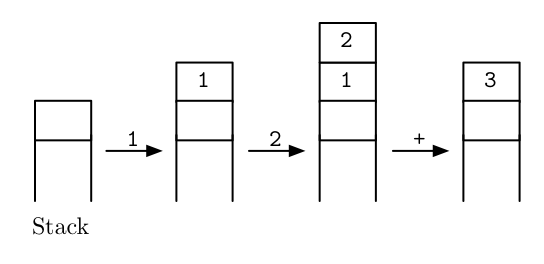
To see how that eliminates the need for parenthesis, take a look the program
1 2 + 3 4 + +which calculates the sum (1+2)+(3+4).
To build our dictionary tree, we are going to devise a very similar
language. Instead of integers, the stack will store whole trees. In
analogy to the numerals, there will be an instruction for pushing a
Leaf onto the stack; and in analogy to +,
there is going to be an instruction for applying the Branch
constructor to the two topmost subtrees.
Here’s the program for building the tree, stored as a string:
program :: String
program = "__5__4H___3VS__F___2 UI__L__+_ R__P___1JWAE"
       ++ "__6__=B__/_XD__C__YKN__7_Z__QG__8_ __9__0 OMT "
Each character represents one instruction. The underscore
'_' pushes a Leaf onto the stack while all the
other character push a Branch tagged with the character in
question onto the stack. The interpreter for this tiny programming
language can be written using a simple left fold:
dict = interpret program
where
    interpret         = head . foldl exec []
    exec xs       '_' = Leaf         : xs    -- push Leaf
    exec (x:y:xs)  c  = Branch c y x : xs    -- combine subtrees
The stack xs is represented as a list of trees.
Deforestation
We have found a concise way to represent the morse code dictionary in source code, but cleverness does not end here. For instance, how about eliminating the tree entirely?
Chopping trees
Call graph
More precisely, it seems wasteful to construct the dictionary tree by
creating leaves and connecting branches only to deconstruct them again
when decoding letters. Wouldn’t it be more efficient to interpret the morse code tree as a call graph
rather than as a data structure Tree Char?
In other words, imagine say a function e corresponding
to the node labeled ‘E’ in the tree, and working as follows:
e :: MorseCode -> Char
e ('.':ds) = i ds
e ('-':ds) = a ds
e []       = 'E'
If the next symbol is a dot or dash, we proceed with the functions
i or a corresponding to 'I' and
'A' respectively. And in case we have already reached the
end of the code, we know that we have decoded an 'E'. The
functions i and a work just like
e, except that they proceed with other letters; and the
morse code tree becomes their call graph.
A combinator…
Now, writing all these functions by hand would be most error-prone and tedious, they all look the same. But abstracting repetitive patterns is exactly where functional programming shines; we are to devise a combinator that automates the boring parts of the code for us.
What does this combinator look like? Well, the non-boring parts are the letter it represents and the two follow-up functions, so these will be parameters:
combinator :: Char                   -- letter
           -> (MorseCode -> Char)    -- function for dot
           -> (MorseCode -> Char)    -- function for dash
           -> (MorseCode -> Char)    -- result function
That’s all we need; we can implement
combinator c x y = \code -> case code of
    '.':ds -> x ds
    '-':ds -> y ds
    []     -> c
which allows us to write
e = combinator 'E' i a
i = combinator 'I' s u
... etc ...
…revealed!
But wait, what have we done? The type signature of
combinator looks exactly like that of
Branch :: Char         -- letter
       -> Tree Char    -- tree for dot
       -> Tree Char    -- tree for dash
       -> Tree Char    -- result tree
but with the type Tree Char replaced by
(MorseCode -> Char)! In fact, let’s rename the
combinator to lowercase branch
branch c x y = \code -> case code of
    '.':ds -> x ds
    '-':ds -> y ds
    []     -> c
and observe that the tree of functions now reads
e = branch 'E' i a
i = branch 'I' s u
... etc ...
or
e = branch 'E' (branch 'I' ... ) (branch 'A' ...)if we inline the function definitions. But this is of course just the
tree from the section on dichotomic
search with each Branch replaced by
branch!
In other words, branch is like a drop-in replacement for
the constructor Branch. To implement the morse code tree
directly as functions instead of as an algebraic data type, we simply
replace every occurrence of Branch with branch
in our previous code. Thus, we have a new implementation
dict :: MorseCode -> Char
dict = interpret program
    where
    interpret         = head . foldl exec []
    exec xs       '_' = leaf         : xs    -- push leaf
    exec (x:y:xs)  c  = branch c y x : xs    -- combine subtrees

decodeLetter = dict
where
leaf = undefinedis a trivial replacement for the Leaf constructor.
A chainsaw called ‘catamorphism’
Derivation
To further understand how and why the replacement of
Branch by branch works, it is instructive to
derive it systematically from just the program text.
In particular, consider the implementation of
decodeLetter from the earlier
section on dichotomic search:
decodeLetter :: MorseCode -> Char
decodeLetter = tag . foldl (flip step) dict
    where
    step '.' = left
    step '-' = right
In this formulation, the focus is on the recursion over the input
string performed by foldl, neglecting the recursive descent
into the dictionary tree. Let’s systematically rewrite this code to
highlight the latter.
First, we interpret it as converting the dictionary tree into a function that decodes letters
decodeLetter = decodeWith dict

decodeWith :: Tree Char -> (MorseCode -> Char)
decodeWith dict = tag . foldl (flip step) dict
    where
    step '.' = left
    step '-' = right
Then, we turn the foldl into explicit recursion
decodeWith dict []     = tag dict
decodeWith dict (d:ds) = decodeWith (step d dict) ds
    where
    step '.' = left
    step '-' = right
and dissolve the step function into the pattern
matching
decodeWith dict []       = tag dict
decodeWith dict ('.':ds) = decodeWith (left  dict) ds
decodeWith dict ('-':ds) = decodeWith (right dict) ds
We group the pattern matching on the input code into a case expression
decodeWith dict = \code -> case code of
    []       -> tag dict
    ('.':ds) -> decodeWith (left  dict) ds
    ('-':ds) -> decodeWith (right dict) ds
and finally, we replace the field selectors by pattern matching on
the tree, also noting the case of Leaf:
decodeWith Leaf           = undefined
decodeWith (Branch c x y) = \code -> case code of
    []       -> c
    ('.':ds) -> (decodeWith x) ds
    ('-':ds) -> (decodeWith y) ds
The recursion on the tree is apparent now, decodeWith
simply traverses both subtrees and combines the results. We can make
this even more evident by appealing to the combinator we defined in the
previous section:
decodeWith Leaf           = leaf
decodeWith (Branch c x y) = branch c (decodeWith x) (decodeWith y)
In other words, decodeWith takes a tree and simply
substitutes each Leaf constructor with leaf
and each Branch constructor with branch.
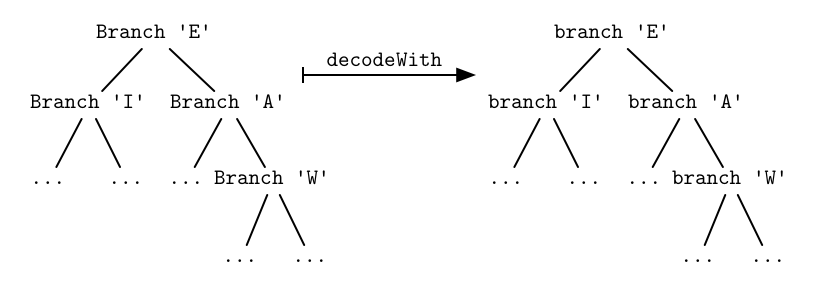
Of course, first using Branch and then replacing it with
branch is a waste; we should rather use branch
from the start and thus cut away the intermediate tree. That’s exactly
what we’ve done in the previous section!
General pattern
Replacing constructors is a very general pattern, not restricted to binary trees. For instance, you probably know following function:
foldr f z []     = z
foldr f z (x:xs) = x `f` foldr f z xs
It’s the good old fold! And at its heart, it just replaces
the constructors of the list data type: z is the substitute
for the empty list [], and f is put in lieu of
the (:) constructor.
In its honor, any function that substitutes constructors in such
fashion is known as a generalized fold. A more exotic
but commonly used alternative name is “catamorphism”. In other words,
decodeWith is a catamorphism.
In this generality, the idea of deforestation is that instead of first constructing a data structure and then chopping it up with a catamorphism, it is more efficient to saw the pieces properly at the time of creation. For example, creating a list and then adding all elements
sum [1..100] = foldr (+) 0 (enumFromTo 1 100)is less efficient than adding the elements as they are created
sumFromTo a b                            -- changes to enumFromTo
    | a > b     = 0                      -- 0 replaces []
    | otherwise = a + sumFromTo (a+1) b  -- + replaces (:)
Merging two functions in this fashion is also called fusion.
Performing deforestation manually, as we did, sacrifices reusability:
the morse code tree only exists as a call graph and cannot be printed
out anymore, and sumFromTo is not nearly as useful as are
sum and enumFromTo were.
Hence, the goal is to teach the compiler to automatically fuse catamorphisms with their structure creating counterparts, the so called anamorphisms. That’s what efforts like a short-cut to deforestation and the recent stream fusion are set out to do, yielding dramatic gains in efficiency while preserving the compositional style.
Where to go from here
I hope you had fun doodling around with morse code; I certainly did. If you long for more, here a few suggestions:
Cutting words
While we’re at it, the intermediate lists created by
words in
decode = map decodeLetter . wordscan be deforested as well and fused into the letter decoding. Try it yourself, or see the example source code.
Polish notation and parsing
Polish notation, the converse
of reverse polish notation, puts function symbols before their arguments
and is thus closer to the Haskell syntax. When the arities of the
functions are known in advance, like 2 for Branch and 0 for
Leaf, this notation doesn’t require parenthesis either.
Write a program in polish notation and a corresponding tiny
interpreter to create the morse code tree.
Comparing to C
Since deforestation is supposed to make things faster, how about comparing our deforested morse code tree to say an implementation in C? But instead of doing benchmarks, let me give two general remarks on the machine representation.
First, one might think that the call graph we’ve built is compiled to
function calls, with e calling i or
a and each function having different machine code, just as
we originally intended. But this is actually not the case. When defined
with branch, the functions are represented as closures, sharing the same machine code
but carrying different records that store their free variables
c, x and y. This is not very
different from storing c, x and y
in a Branch constructor. Template Haskell or some kind of partial evaluation would be
needed to hard-code the free variables into the executable. For more on
the Haskell execution model, take a look at the GHC
commentary.
Second, all our implementations decipher a letter by follow a chain of pointers: descending a tree means following pointers to deeper nodes, and making procedure calls means repeatedly jumping to different code parts. This of course raises questions of cache locality, branch prediction or memory requirements for storing all these pointers.
In C, however, there is another technique available: instead of following a chain of pointers to get to the destination, the address of the final stop is calculated directly with pointer arithmetic. The following example illustrates this:
#include <stdio.h>
#include <string.h>
char buf[99], tree[] = " ETIANMSURWDKGOHVF L PJBXCYZQ  ";
int main() {
    while (scanf("%s", buf)) {
        int n, t=0;
        for(n=0; buf[n]!=0; n++)
            t = 2*t + 1 + (buf[n]&1); /* compute destination */
        putchar(tree[t]);             /* fetch letter */
    }
}
Here, the tree is represented as an array and paths to nodes are
encoded as (zero-less) binary numbers. The program calculates the path
t to the proper letter and then fetches it with an O(1)
memory lookup. Compare also the morse code translator by
reddit user kayamon.
Since the number of memory accesses is kept to a minimum, this technique is the most efficient; but it is impossible to reproduce with algebraic data types alone. Fortunately, arrays libraries are readily available in Haskell as well.
The main drawback of this approach, and of arrays in general, is the lack of clarity; indices are notorious for being non-descript and messy. The raw index arithmetic in the example C code above sure seems like magic!
Such magic is best hidden behind a descriptive abstract data type.
How about rewriting the example in Haskell such that
decodeLetter looks exactly like the one in the section on dichotomic search? In other
words, the abstract data type is to support the functions
left, right and tag. One possible
solution can be found in the source
code accompanying this article.